From Students to Scientists
Article by: Lisa Lopez Snyder
Originally Published
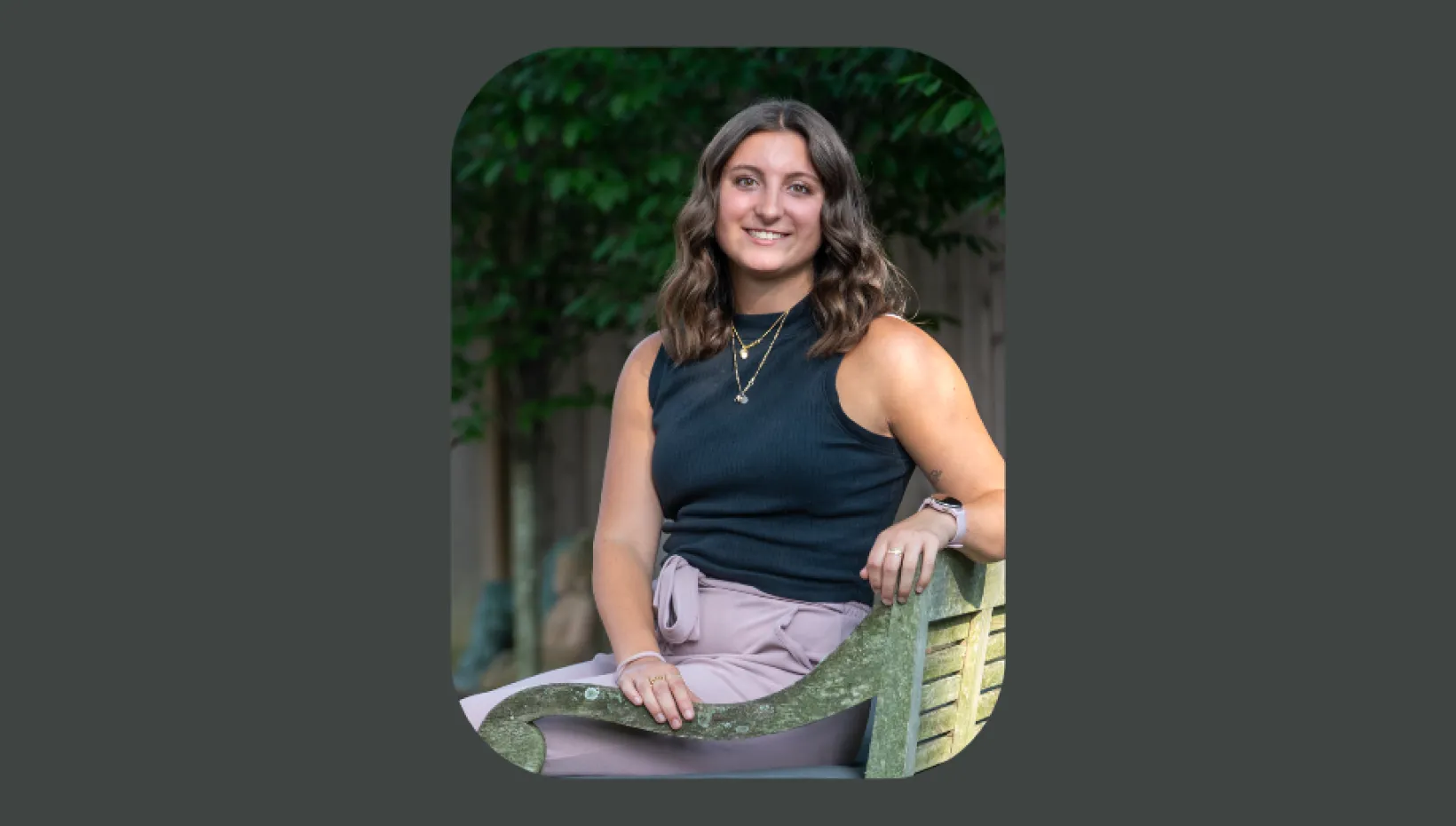
In the summer of 2025, second-year veterinary student Jovanna Fusco worked in the lab of her mentor, Cody Warren, PhD, MPH, an assistant professor in the Department of Veterinary Biosciences, making precision-cut lung slices from donor swine and human lung tissue, then growing the tissue in culture.
Her goal: Create a model that researchers can use to study how avian influenza can replicate in swine and human tissues. She succeeded.
The model supported the growth of several influenza viruses, providing researchers with a model to examine the spread and evolving nature of influenza viruses, says Michael Oglesbee, DVM ’84, PhD ’88, DACVP, professor in the Department of Veterinary Biosciences and director of The Ohio State University College of Veterinary Medicine Summer Research Program.
“Jovanna’s work showed that human tissues supported infection by a swine-origin influenza D virus, which is important in understanding the emergence of novel influenza strains that can cause epidemics or possibly pandemics in people,” said Oglesbee, who is also director of Ohio State’s Infectious Diseases Institute.
Jovanna Fusco’s research efforts were made possible through The Ohio State College of Veterinary Medicine’s 14-week Veterinary Scholar Summer Research Program, which offers students impactful research opportunities early in their veterinary medicine studies.
“This is just one of many examples of the important role our veterinary students play in making important scientific discoveries that can have far-reaching impacts on animal and human health,” said Christine Petersen, DVM, PhD, associate dean for research and graduate studies and Robert H. Rainier Endowed Chair in Industrial Veterinary Medicine and Research.
Advancing student research interests
Established in 2009 with support from the National Institutes of Health (NIH), the program aims to develop the next generation of veterinary scientists by supporting student research interests that address issues ranging from improving animal and human health to ensuring food safety and advancing wildlife conservation.
Each spring, veterinary students apply by submitting a project proposal based on their interests, Oglesbee said. Students can view a list of principal investigators on the program’s website and talk with other students as they develop their proposals. While most faculty mentors are from the College of Veterinary Medicine, others have included research faculty from the College of Medicine, the College of Food, Agricultural and Environmental Sciences and other colleges at Ohio State, he said.
“The program is really student-driven. Students seek out faculty because they’re interested in a particular medical specialty,” said Oglesbee. “Projects are widely diverse, ranging from microbiome science, antimicrobial resistance and infectious disease to comparative oncology, metabolic disease and behavior-based research in companion and farm animals."
Students develop their project proposals after identifying a faculty mentor. In some instances, the project is a 50/50 collaboration; in others, the student drives the majority of the project proposal, he notes. “The goal is to have a standalone project that aligns with the mentor’s research focus and is publishable in a peer-reviewed scientific journal.”
The college’s Council for Research reviews proposals, and each year, 20 to 25 students are accepted. Funding comes from an NIH training grant, along with support from Boehringer Ingelheim, the Morris Animal Foundation, the American Veterinary Medicine Foundation and individual donors.
“Although funding for this program has been supported in part by the NIH, that funding is scheduled to conclude. Along with corporate support from Boehringer Ingelheim and contributions from individual donors, it will be essential for the college to establish a reliable and sustainable source of funding to ensure the continuation of this impactful program, which plays a vital role in preparing our future veterinary researchers,” said Rustin Moore, DVM ’89, PhD ’94, DACVS, Rita Jean Wolfe Endowed Dean at Ohio State’s College of Veterinary Medicine.
Fusco, who had no prior research experience, said her interest in animal and human health and preventing future disease outbreaks drove her to apply. She is also pursuing a Master of Public Health (MPH-VPH) as a dual-degree student.
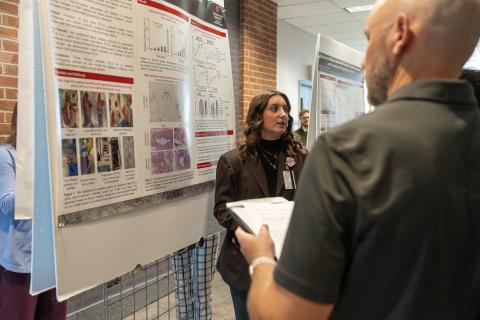
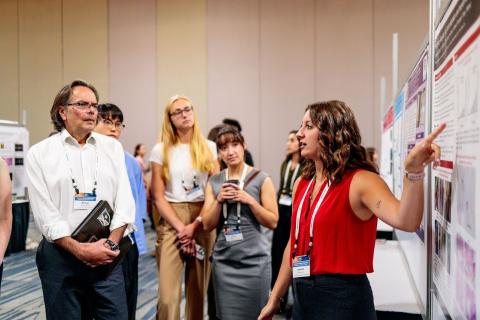
As part of the program, students attend regular brown bag seminars and participate in a journal club. Some funds support travel to the National Veterinary Scholar Symposium, where students present research posters alongside peers from summer research programs across the U.S., Western Europe and the Caribbean. The 2025 symposium in Spokane, Washington, brought together 750 participants from around the globe.
Pipeline impact
The summer research program has a strong record of building the next generation of veterinary scientists, Oglesbee said. Since its inception, 55% of students funded through the NIH training grant have enrolled in a graduate program. Sustaining that impact will require continued support, he added, particularly since the NIH training grant ends in 2028.
“Veterinary students interested in research can not only seek out opportunities that interest them through the program but also gain hands-on experience.”
— Dr. Melissa Leonard
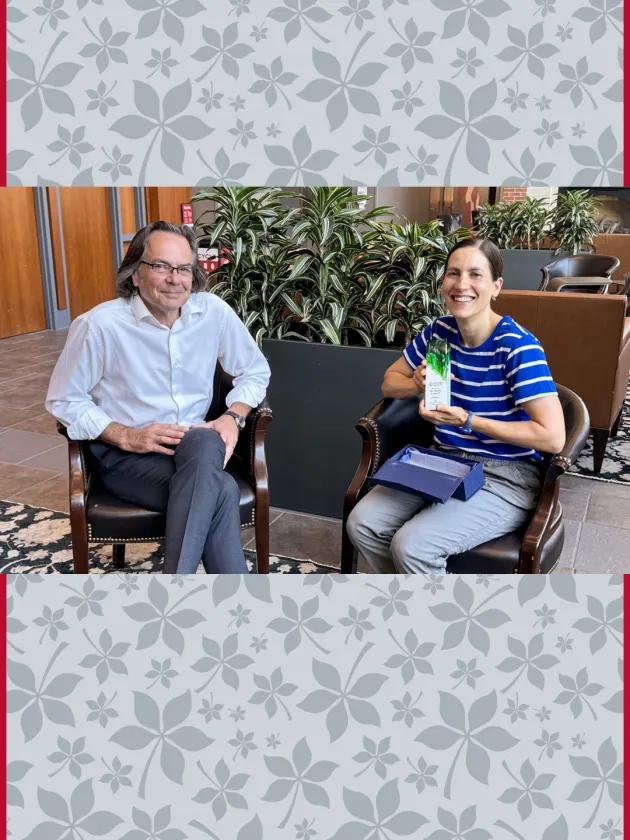
The summer research program had a tremendous impact on Melissa Leonard, DVM ’17, ’PhD ’25, who recently completed her doctorate in Immunology at Ohio State.
After graduating with her DVM, Leonard spent two years in practice before returning to Ohio State in 2020 to pursue research on developing novel therapeutics to improve health outcomes in animals and humans as part of a combined veterinary pathology training/PhD program.
In August 2025, she received the prestigious Boehringer Ingelheim Research Award for Graduate Veterinarians for her work investigating the molecular mechanisms that regulate T cell migration and effector function during influenza infection. During her studies, she completed her pathology boards and was named to a fellowship supported by an NIH training grant for two consecutive years.
“Seeing how scientific discoveries are translated into clinical applications really helps you develop a strong appreciation for medicine—I hope my experience can inspire others.”