From Bench to Barn
Article by: Jessi Behrendsen
Originally Published
When Brittany Craig talks about her horse Luke, she sounds equal parts exhausted, relieved and fiercely devoted. For more than a year, Craig’s 17-year-old Thoroughbred battled a lower-leg wound that simply would not heal. The injury first appeared around Thanksgiving 2024. What followed was an exhausting cycle of treatments, surgeries, bandage changes and setbacks.
“There were days I just thought, ‘What else do we do?’” Craig said. “We tried everything.”
Luke underwent ultrasounds and X-rays. Veterinarians searched for an underlying cause. They removed the damaged tissue, but the wound still refused to heal.
Craig and her veterinary team tried laser therapy, pressure wrapping, manuka honey and a newer wound application product. At one point, Luke reacted so severely to a treatment that the wound dramatically worsened. “It was awful,” Craig said. “I felt terrible for him.”
Luke remained on prolonged stall rest and required daily bandage changes. For months, Craig drove to the barn before and after work to care for him.
She worried constantly about infection, reinjury and whether the wound would ever close.

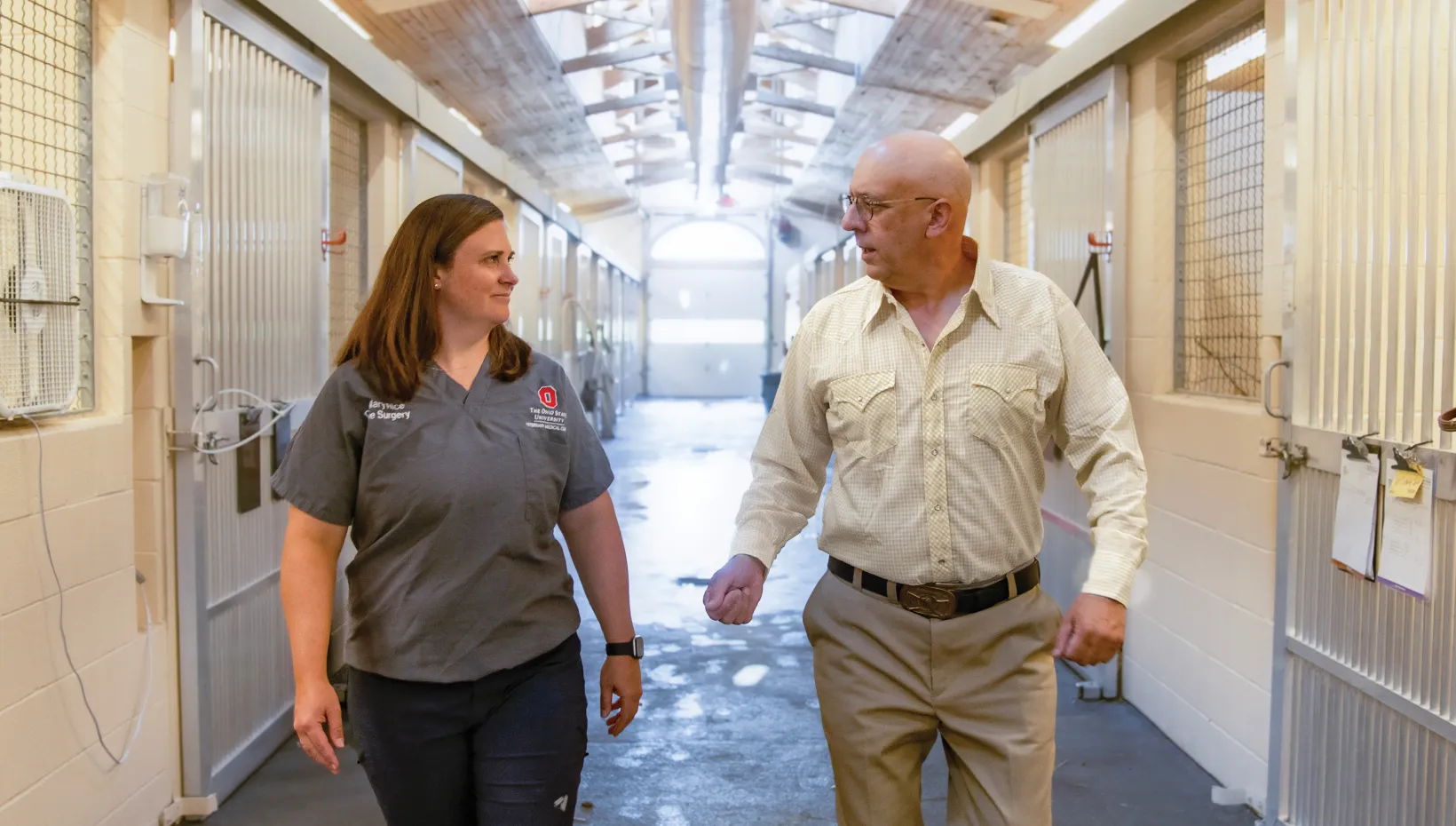
Eventually, they referred him to The Ohio State University Veterinary Medical Center, where Hilary Rice, DVM, MS ’19, DACVS, clinical assistant professor of
equine surgery at The Ohio State University College of Veterinary Medicine, discovered a necrotic section of his extensor tendon.
Luke and Craig were then introduced to a new possibility: an experimental peptide therapy developed through a collaboration between veterinary and human medicine researchers. For Craig, it felt like one final chance. “I said, ‘Absolutely, I’m game for anything’.”
What happened next gave researchers reason to believe the therapy could someday reshape the treatment of chronic equine wounds.
A Stubborn Problem in Horses
Lower-leg wounds are among the most common and frustrating injuries veterinarians treat in horses.
“These are a large percentage of the cases that we see,” Rice says. “Whatever we can do to speed up healing is beneficial for both the patient and the owner.”
Unlike humans, horses often struggle to heal wounds below the knees and hocks. Limited surrounding skin, constant motion and poor blood supply create ideal conditions for delayed healing.
Complicating matters further is a condition horse owners know all too well: proud flesh. Proud flesh, formally called exuberant granulation tissue, occurs when healing tissue continues growing beyond the surface of the wound. Once that tissue rises above the surrounding skin, new skin cells can no longer migrate across the wound.
“That’s the key problem,” said Thomas L. Cherpes, DVM, MD, professor in the Department of Otolaryngology at The Ohio State University College of Medicine and an adjunct professor in the College of Veterinary Medicine. “You can think of healing in the horse limb as a race. You need to get it closed before the granulation tissue builds too high and new skin cells can’t cover the wound.”
Traditional treatments often involve repeatedly trimming excess tissue surgically or using steroid ointments short-term to suppress inflammation.
Those approaches can help, but they also require intensive management and don’t always work.
“There are a million wound products on the market because there’s not one product that works for every horse,” says Caitlin Moreno, DVM, MS ’23, DACVS, former assistant professor of equine surgery at Ohio State and now owner of EVE Surgical and Referral Center in Lancaster, Ohio.
Moreno says horse wounds often become trapped in an inflammatory phase of healing.
“Horses tend to overdo themselves in terms of inflammation and granulation tissue,” she says. “If we could skip that altogether and get right to skin healing, it would really speed up the process.”
An Idea Rooted in Human Health Research
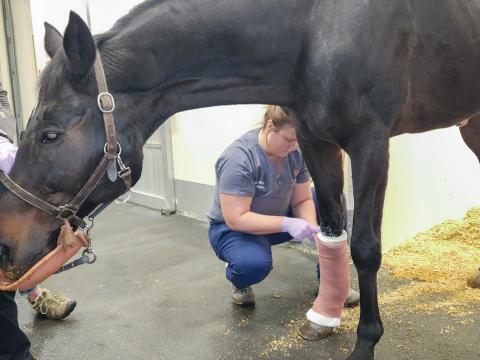
The peptide therapy did not begin in a horse barn. It began in Cherpes’ human health research lab.
Cherpes, who is both a physician and veterinarian, originally studied the peptide’s potential role in improving health in post-menopausal women.
As researchers observed how effectively the peptide stimulated epithelial growth — the process that allows skin and tissue cells to spread across a wound
— Cherpes and technology co-inventor Rodolfo D. Vicetti Miguel, MD, with Ohio State’s College of Medicine Department of Otolaryngology, saw another opportunity.
“Distal limb wounds in the horse are notoriously difficult to repair,” he says. “This makes the horse a challenge for our peptide and a really compelling model.”
The peptide works by accelerating re-epithelialization, helping skin cells migrate more quickly across the wound surface before excessive granulation tissue can take over.
Researchers launched an initial pilot study at Ohio State. The study received support from the Consortium for the Advancement of Neuromusculoskeletal Locomotion, or CANCL, one of the college’s signature interdisciplinary programs. A second study received funding through an equine intramural grant from the college.
The research team treated wounds with varying peptide concentrations while remaining blinded to which wounds received the active treatment. Still, the results became difficult to ignore.
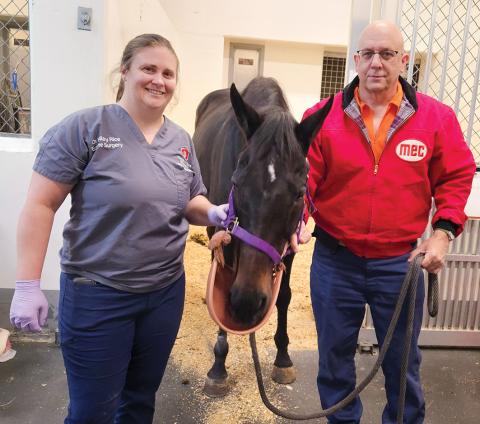
“It started to become apparent pretty quickly which wounds were receiving the treatment,” Moreno said. “Many of them were healing much faster and weren’t
forming the granulation tissue compared to the placebo.” The studies ultimately showed that wounds treated with the peptide healed faster, developed more organized tissue and appeared safe for use. "We clearly showed the wounds healed more quickly,” Cherpes said. The work also reinforced the value of cross-disciplinary collaboration.
From Research Study to Real Patient
While the controlled research studies showed promise, Luke became one of the team’s first opportunities to use the peptide in a naturally occurring chronic wound.
By the time Luke returned to Ohio State for the second time, Craig said she had run out of options. Rice and Moreno alternated clinical responsibilities while managing his treatment and bandage changes. Craig visited frequently and received regular photo updates documenting the wound’s progress.
“It was an emotional roller coaster,” Moreno said. “Every time we changed the bandage, everybody was wondering if we were finally turning the corner.”
Gradually, they were.
The wound began shrinking. Healthy tissue formed. Skin started closing over the once-open defect.
For Craig, seeing the progress unfold week by week was overwhelming. “It was finally like, ‘Oh my gosh, he actually gets to come home,’” she said.
Researchers say Luke’s recovery reinforced what they had already observed in their studies. “We’ve been able to heal wounds in patients that had issues healing for months, if not years, with just a handful of treatments,” Rice says.
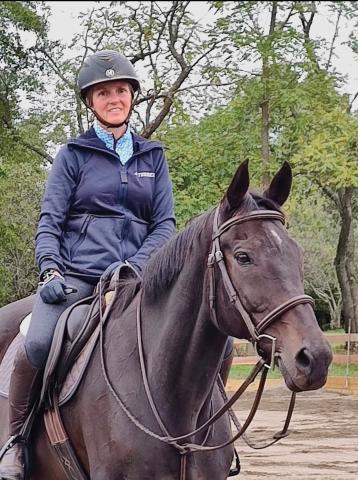
Today, Luke is back home with Craig and slowly returning to normal life. “He’s outside again and acting like himself,” she says. “That’s all I wanted.”
A Broader Future for Equine Wound Care
The peptide remains experimental and is currently only available through approved research protocols at Ohio State. Researchers caution that horse owners cannot yet request the treatment through general veterinary clinics. Still, the long-term possibilities are significant.
Moreno believes the therapy could eventually offer horse owners a safer, more practical way to manage chronic wounds without prolonged hospital stays.
“There are a lot of people who don’t have the resources to keep their horses hospitalized for months,” Moreno says. “If we could create something safe, effective and easy to use, that would make a huge difference.”
Cherpes hopes the research also helps position Ohio State as a leader in equine wound-healing innovation. “There’s something to be said for becoming a center of excellence in this space,” he says.
For Rice, the impact becomes most visible in moments like watching a horse finally heal — and seeing the relief that comes with it. “We’ve made some people really happy and helped some horses feel better,” Rice says. “That feels good, too.”
Craig agrees. After more than a year of setbacks, uncertainty and constant care, she said watching Luke recover felt almost unreal. “I’m hoping they’re able
to keep developing this because it definitely worked when nothing else did,” she says.