Global Engagement Travel Awards
The Global Engagement Program offers two travel award tracks: Domestic Awards, which support clinically-oriented experiences within the U.S. for DVM students, and Global Awards, which support research, clinical training, service learning, and other applied One Health experiences anywhere in the world for CVM graduate and professional students. Both awards fund immersive activities that expand students' technical and cultural competencies and help prepare them for exciting and fulfilling careers in veterinary medicine.
Global Engagement Program Section Links
Travel Award Information
Start here!
Domestic Award eligibility: Open to full-time DVM students in good academic standing. Travel must be clinically oriented and should not conflict with regular academic courses.
Global Award eligibility: Open to full-time DVM, MS or PhD students in the College of Veterinary Medicine, or MPH-VPH students, in good academic standing. Graduate students in other colleges with CVM mentors, interns and residents are considered on a case-by-case basis. Travel may be for research, clinical training, service learning or other applied One Health experiences, for a minimum of one week.
*For international destinations, successful completion of VETPREV 7760 (Opportunities in Global Veterinary Medicine and Public Health), VETBIOS 7802 (International Veterinary Medicine Experience), or the asynchronous pre-departure preparation CarmenCanvas modules (not-for-credit) is a prerequisite for receiving the award. Students taking global education courses that are already subsidized by the Global Engagement Program (e.g., Thailand, Madagascar) are not eligible for additional travel awards for the same trip. Trips to locations with current US State Department Travel Advisory Level 3 and above require additional justification and may not be funded.
Amount of individual awards will vary but typically range from $500 - $5,000. The College of Veterinary Medicine has different mechanisms to award funds, such as directly purchasing flights to awarding scholarships directly to the student's bursar account. Upon receiving an award, students will work with the Global Engagement Program and Student Financial Services to determine the best award mechanism.
Proposed budgets are evaluated based on cost-effectiveness, detail, eligibility, and accuracy. Eligible expenses include costs directly associated with travel, including transportation (airfare, taxi/rideshare), lodging, food, travel-related vaccines covered by insurance, and supplemental travel insurance required by OIA for international trips. Ineligible expenses include gifts for hosts, course fees, research/clinical materials, or other durable goods (e.g., clothing/equipment).
International trips must include budget for supplemental travel insurance from OIA. To find the expected costs for lodging and food in different locations please check the US government sites (domestic) (international) as well as local contacts/ hosts.
It is strongly recommended that students demonstrate some level of personal financial contribution and/or attempt to secure additional sources of funding. Travel awards are not expected to fully cover all costs associated with the student's trip, and students should be aware of additional expenses they may incur by taking the trip.
Once the application is selected for funding by the committee, the student must sign a letter of award including the following certifications:
- Agreement to use the award funds for the proposed travel within one year
- Successful completion of the pre-requisite course
- Health insurance for the trip has been obtained
- Relevant ethical compliance has been completed (e.g., IACUC, IRB review), if the trip includes research with animals or human subjects
- Agreement to comply with all relevant University policies during the experience
- Agreement to present details of the experience upon return including an approximately 200-word summary of the experience, at least 2 high-quality photos and a digital video or in-person presentation at a global engagement event on campus.
- Agreement to engage with and provide stewardship to donors, either in person or via videoconference (with the dean and/or advancement team), who provide funding for this program.
- Agreement to acknowledge the program’s support in any presentations or publications based on the experience
If students opt to receive award funds as a scholarship, please be aware that they will be included as part of their total financial aid for the semester/year, which may impact the level of financial aid for which they are eligible.
Global and Domestic Travel Awards
Applications contain three parts and must be completed fully:
- Summary information (demographic, name/location/dates of travel, mentor)
- Narratives (description of experience and alignment with professional goals)
- Budget with detailed description/source of costs
Domestic Awards:
- For DVM students: Clinically-oriented experiences in the U.S.
- Deadline: Submit 4 months before your trip
Global Travel Awards:
Deadlines:
- For CVM graduate/professional students: Research, clinical, service learning or applied One Health experiences anywhere in the world
- Autumn 2026, 5 p.m. EST – October 2, 2026
- Spring 2027, 5 p.m. EST – March 12, 2027
Please direct any questions to CVM-GlobalEngagement@osu.edu.
Funded Experiences
Each year, the Global Engagement Program is able to fund several travel scholarships. These unique opportunities provide learning experiences for College of Veterinary Medicine Students based on their individual interests.
-

Megan Andries
Master of Public Health
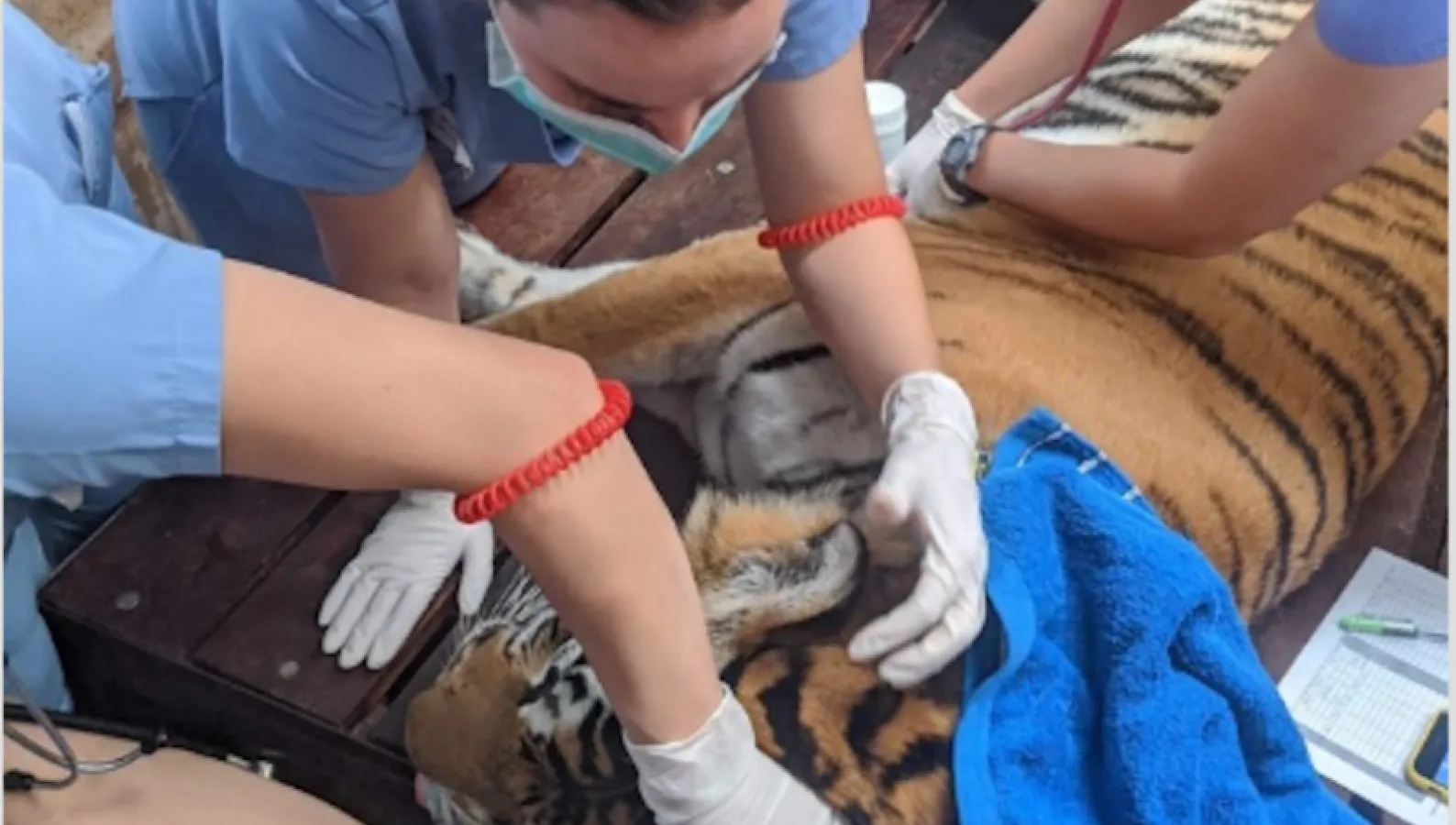
DVM Class of 2027Sydney, AustraliaMy rotation took place at the Taronga Zoo and Wildlife Hospital - one of the largest and most state-of-the-art wildlife hospitals in the world. I will be able to sharpen my skills in all things wildlife medicine ranging from case diagnosis to surgery under the supervision of renowned wildlife veterinarians. This will be an invaluable experience for me as I intend to dedicate my veterinary and public health career to wildlife medicine and conservation as well as research geared towards finding solutions to global issues such as human-wildlife conflict and livestock-wildlife disease transmission. Having grown up in South Africa, my current wildlife experience stems from working remotely in the bush and with limited resources. This experience will provide me with the opposite end of the spectrum where wildlife can receive gold-standard care, filling in gaps in my current knowledge. I am grateful for the experience and remain ever-appreciative of the support.
-

Alycia Kent
DVM Class of 2026Glennallen, AlaskaThe Copper Basin 300 is a winter dogsled race held each January, beginning in Glennallen, Alaska. The race takes place across what is known to be the toughest 300 miles in Alaska. The veterinary team is essential in clearing dogs for the race as well as ensuring their health and safety along the course. This year, there were 35 teams, each consisting of 12 dogs and a musher. Our vet team performed pre-race checks on each dog as well as care at each check point where mushers stopped throughout the day and night. I was incredibly excited to experience my first sled dog race and immerse myself in this unique culture. The athleticism of the dogs and mushers is remarkable, and I was thrilled to be part of a team that ensures the safety of each animal. And thankfully I didn’t freeze in the January Alaskan tundra!
-

Sahana Prabhu
DVM Class of 2026Gurugram and Tiruchirappalli, IndiaI was grateful to receive this award which allowed me to experience veterinary medicine in India during my clinical year. As an Indian American, my passion for veterinary medicine is rooted in cultural values that emphasize the importance of animal welfare. My ultimate goal is to contribute to veterinary medicine as an ophthalmologist. In January, I spent two weeks at The Eye Vet, a specialty ophthalmology clinic in Gurugram, India, where I built professional connections and gained insight into how research and clinical advancements differ internationally. I also spent one week at Rathna’s Pet Clinic, a small animal general practice in my parents’ hometown of Tiruchirappalli, India. I used my Tamil language proficiency and gained cultural insight by connecting with the local community. This priceless experience provided the opportunity to become a more culturally competent veterinarian, advocate for varying perspectives, and gain exposure to research conducted outside the U.S.
-

Sophia Schwartz-Cutler
DVM Class of 2026Portland, Eugene and Roseburg, Oregon
In spring 2026, I will travel to the Pacific Northwest to expand my large-animal veterinary education through rural community practice, with a concentration in production medicine. I grew up with extensive horse experience and completed a BS in Animal Science at the University of Vermont before pursuing graduate studies at Ohio State. My professional interests lie primarily in livestock and farm-animal medicine, with a particular focus on rural practice and ruminant health. This travel opportunity will allow me to immerse myself in rural ambulatory practice, develop a deeper understanding of the region’s specific care needs, and begin building trust and rapport with local industry stakeholders.